

 |
| Located outside the city of Karaganda, the Karlag political prison occupied a large plot of land with various prison quarters, nurseries, schools and hospitals. The old administration building is now a museum open to tourists. |
 |
Stalins portrait hanging in the administrator's office. The Karlag, like all gulags, was distantly controlled by Stalin in Moscow.
|
 |
| For the sake of tourism, the basement of the administration building was reconstructed to mimic the old prison cells. With added wax models. |
 |
| New arrival gets a mugshot. |
 |
| Home sweet home |

 |
| Large mural of young Stalin and Lenin. |
 |
| Children were separated from their inmate parents, brought up in nurseries and went to orphanages at age four. Lack of nurture and quality of life was detrimental to both children and parents. |
 |
| According to legends, a traditional Kazakh rock hard cheese ball "kurt" was thrown over the prison walls by local Kazakh people. The salty ball was thought to be stones by the Soviet guards and the prisoners themselves took awhile to understand they were edible. Kurt is was used by older generations as a source of protein in the winter. Today they can be found by the checkout stands in shops all around Kazakhstan (photo above). |
 |
| Guard's gun. |
 |
| Prisoners played music and sang on holidays. |
 |
Increasingly ambiguous counter-revolutionary laws of the late 1930's boomed the gulag populations. The Karlag prison found itself overcrowded not only with common folk but also famous scientists, physicians and mathematicians. Some were granted access to textbooks and laboratory space to continue their work.
|
 |
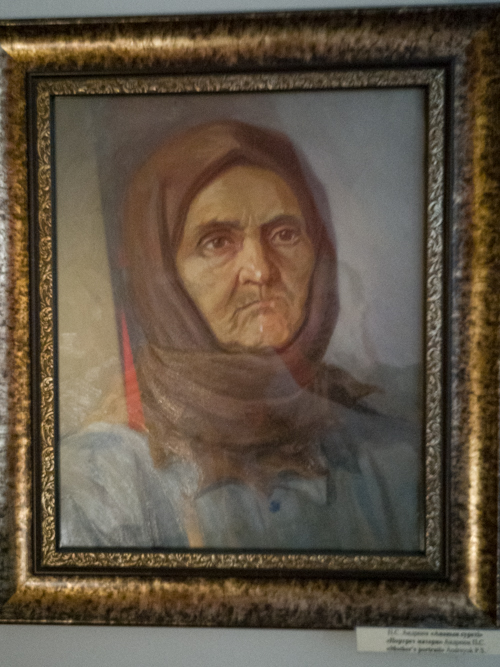
| The museum has a room full of small scale paintings. These paintings were painted by the prisoners themselves during the time of the Karlag's existence from 1931-1959. |
 |
| Self portrait by prisoner. |


The number of casualties from the Soviet's Gulag prisons are hotly debated.
-
For in-depth accounts: Kolyma Stories and Gulag Archipelago.


