Showing posts with label village. Show all posts
2.5.14
25.4.11
Vabukori Village
Motu village 15 minutes southeast of Moresby.

One of Vabukori's three coves. (looking north towards Port Moresby town)

Karo Obaha, walking a narrow path up to the top of Manuabada Island, land where his forefathers of the Kwabira Laurina Keia Sere Besena clan used to make gardens. A small number of villagers live on the island, which is swarmed by village fishermen during the week and attracts outside visitors for picnics on the weekend.

Vavia George frying bahu (leftovers), maniota and meat on a fire in the kitchen of his stilt house.

Vavia's wife and their three kids in the living area. The smallest child is rocked to sleep in the bilum (stringbag).

The Lavi family having a rest on their front porch while their animals play around the house.

Ganiga Dabu, one of the oldest women in Vabukori. She became known as Vabu Kivio when her husband Kivio Gima passed away. This is the norm in Motuan custom, whereby a widow is addressed by the name of their late husband. Vabu Kivio has witnessed rapid changes in the village and often yearns for the days of old, when life was simple and the village was less crowded.

Gulf woman, Claire Mape, collecting shells on the beach. The shells will be cooked inside an oven to make lime, then bottled and sold in Moresby.

22.2.11
Born here, die here
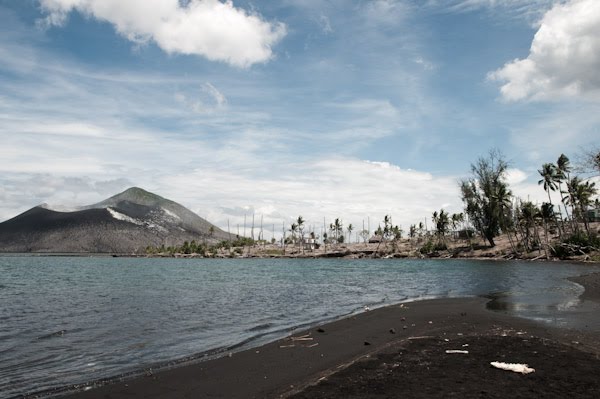
The image of a small tropical secluded island with too many coconut trees, green volcano landscapes and the old glowing town of Rabaul just a short walk away pictures something too beautiful for my mind see. A sound paradise for the lucky ones born there. The only way to imagine what it was like is by imagining the exact opposite of what Matupit looks like now.


There are many houses in the town with collapsed roofs. Being too expensive to fix, some residents have tried to repair them while others built new homes out of bush materials and scavenged metal scraps.


On Septemeber 19th 1994 ash began spewing out of Mt Tavurvur and Mt Vulcan while the island of Matupit sat in the Simpson Harbor directly inbetween the two volcanos. As the ash became unbearable many of the locals fled to the nearby town Kokopo, while some stubborn locals stayed behind shoveling the constant falling ash off the houses. Weeks later the government granted a large piece of land south of Kokopo for the village to relocate. While some have accepted their new land, others are still making their way back to the once beautiful island. Two to three thousand live on the island today, around 75% of the original population.
Found Menrint James wondering along the beach near his home. While some locals claim the ash has caused no health problems others said the sulpher was causing asthema and tuberculosis.
The locals mentioned the bridge to their island as we drove over it without adding the fact that it was only ash and dirt under the bridge and they did not live on an island anymore.


Palex Tioman with his wife and five kids outside his original house. Palex said he left the village the day the volcanoes erupted but returned the next day. He does not have a job. Coconut planations were the main source of income before the eruptions. Like many locals he survives on fishing and digging for wild fowl eggs near the volcano.


There are many houses in the town with collapsed roofs. Being too expensive to fix, some residents have tried to repair them while others built new homes out of bush materials and scavenged metal scraps.

[Thank you National. The words and some
of these photos were printed in the National's
Weekender paper, February 25th 2011]
of these photos were printed in the National's
Weekender paper, February 25th 2011]
at
9:50 AM
Labels:
apocalypse,
article,
documentary,
matupit,
Papua New Guinea,
photography,
rabaul,
village,
volcano
Subscribe to:
Posts (Atom)